Cacio e Pepe isn’t just a pasta dish—it’s a three-ingredient masterpiece that separates Roman grandmothers from aspiring cooks worldwide. With only Pecorino Romano, black pepper, and pasta, this dish demands perfect technique to transform humble ingredients into silk.
🏛️ The Soul of Roman Simplicity
Born in the Roman countryside as shepherds’ sustenance—carrying only dried pasta, hard cheese, and pepper—this dish has evolved into the ultimate test of culinary skill. While seemingly minimal, its execution requires the precision of a chemist and the intuition of a nonna. In Rome, you can judge a trattoria by its cacio e pepe long before you see the menu.
🛒 Ingredients (Serves 2)
The Sacred Trinity:
- 200–220 g tonnarelli, spaghetti, or rigatoni
(Tonnarelli—square spaghetti—is traditional and holds sauce best) - 140–160 g Pecorino Romano DOP
(Must be DOP designation, aged at least 8 months) - 2 generous tsp freshly cracked black pepper
(Coarse grind from whole peppercorns)
The Secret Fourth Ingredient:
- Starchy pasta water — the magic emulsifier
👨🍳 The Roman Method: Step-by-Step Perfection
1. Prepare Your Mise en Place
- Finely grate Pecorino Romano using the smallest holes of your grater or microplane. Pre-grated will not melt properly—this is non-negotiable.
- Crack peppercorns coarsely using a mortar and pestle or pepper mill. You want texture, not dust.
2. Toast the Pepper
- In a dry skillet over medium heat, toast cracked pepper for 30–60 seconds until fragrant. Do not burn. Set aside in a bowl.
3. Cook the Pasta with Strategy
- Bring 3–4 liters of water to a rolling boil.
- Salt lightly—remember, Pecorino is intensely salty.
- Add pasta and cook 1–2 minutes less than package al dente time.
- DO NOT DRAIN THE PASTA WATER YET.
4. Create the Cheese “Cream”
- Place grated Pecorino in a large, warm (but not hot) mixing bowl.
- Add ½ ladle (about ¼ cup) of very hot pasta water.
- Vigorously whisk with a fork until it forms a smooth, thick paste with no lumps. This is your base.
5. The Critical Emulsification
- Reserve 2 full ladles of pasta water, then quickly drain the pasta.
- Transfer the wet, hot pasta directly into the cheese bowl.
- Immediately start tossing and stirring with tongs or two forks.
- Add reserved pasta water 1–2 tablespoons at a time, tossing continuously.
- The sauce will transform before your eyes: first clumpy, then suddenly silky and glossy as the emulsion forms.
6. Final Touch
- Add toasted black pepper, reserving a pinch for garnish.
- Toss once more until every strand is perfectly coated.
7. Serve with Urgency
- Plate immediately in warm bowls.
- Add a final sprinkle of pepper and perhaps a whisper of grated Pecorino.
- Serve within 60 seconds—this dish waits for no one.
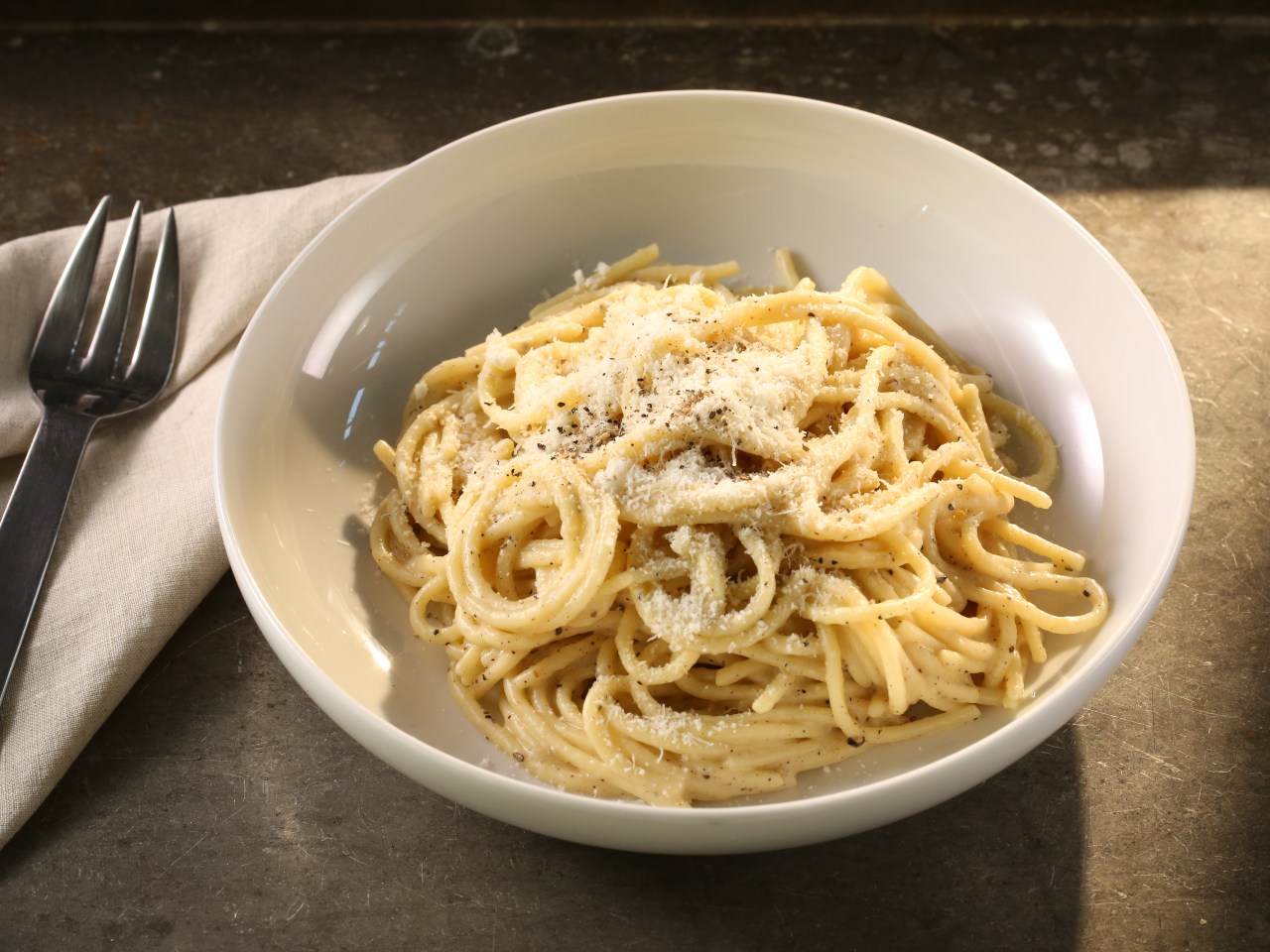
🍝 The Textbook Cacio e Pepe: What Perfection Looks Like
Visual Cues:
- Glossy, Creamy Coating — Each strand should glisten without pooling sauce at the bottom of the bowl.
- No Clumps — The cheese should be completely emulsified, with no granular bits.
- Pepper Distribution — Black pepper speckles every bite, not just sitting on top.
- Perfect Consistency — Sauce should cling to pasta, not slide off; thick enough to coat, thin enough to flow.
Traditional Presentation:
- Served in warm shallow bowls (never deep plates)
- No garnish except perhaps a tiny pepper sprinkle
- No extra cheese at the table—the dish is complete as served
- Accompanied only by a glass of crisp Frascati or chilled beer
⚠️ Non-Negotiable Rules from Roman Kitchens
1. Cheese Protocol
- Only Pecorino Romano DOP — not Parmigiano, not Grana Padano
- Grate immediately before using — oxidation ruins melting properties
- Room temperature cheese — cold cheese from the fridge will seize
2. The No-List (The Roman Commandments)
- No butter — the sauce emulsifies from cheese fat and starch alone
- No oil — interferes with the emulsion
- No cream — this is not Alfredo
- No eggs — you’re thinking of carbonara
- No double boiler — too gentle; you need the heat of the pasta
3. Temperature Control
- Work fast — cheese waits for no one
- Off direct heat — too much heat scrambles the proteins into rubber
- Warm bowls — cold dishes will seize the sauce
4. Pasta Wisdom
- Undercook slightly — it finishes cooking in the sauce
- Never rinse pasta — you need every bit of surface starch
- Tonnarelli is ideal — square shape catches more sauce
🔬 The Science Behind the Silk
Understanding why cacio e pepe works helps you master it:
The Emulsion Explained:
- Pasta starch (amylose and amylopectin) dissolves into cooking water
- Cheese proteins melt and disperse when gently heated
- Starch molecules form a network that traps fat droplets from the cheese
- Mechanical agitation (vigorous tossing) creates a stable, glossy emulsion
- Correct temperature keeps proteins from seizing and fats from separating
Common Failure Points:
- Too hot: Cheese proteins coagulate into rubbery strings
- Too cold: Fats solidify, creating greasy clumps
- Too much water: Sauce becomes watery and won’t cling
- Too little water: Cheese forms a dry, grainy paste
🍴 Regional Variations (Even Romans Debate These)
1. The Traditionalist
- Tonnarelli pasta
- 100% Pecorino Romano
- Pepper toasted in a dry pan
2. The Modernist
- Sometimes 70% Pecorino, 30% Parmigiano for milder flavor
- Pepper briefly cooked with a tiny splash of pasta water to bloom flavor
- Served in a cheese bowl (scalda cacio) for extra richness
3. The Shepherds’ Original
- Often made with shorter pasta like rigatoni
- More pepper (it was a preservative)
- Sometimes a drop of pasta cooking water added to the pepper to “bloom” it
💡 Pro Troubleshooting Guide
| Problem | Cause | Solution |
|---|---|---|
| Clumpy/grainy sauce | Cheese too cold, added too fast | Let cheese reach room temp, add water gradually |
| Watery sauce | Too much pasta water | Toss longer to evaporate, or add more cheese |
| Rubbery strings | Too much direct heat | Work off heat, use hotter pasta |
| Greasy separation | Emulsion broke | Start over with fresh cheese paste, add failed sauce slowly |
| Too salty | Over-salted water or cheese | Use less salt in water, milder cheese blend |
📝 Why This Dish is Legendary
Cacio e pepe is culinary haiku—maximum meaning from minimum elements. In a world of complex recipes, it stands as a monument to technique over ingredients. Romans don’t just eat cacio e pepe; they respect it. Every trattoria has its version, every family its secret, but all agree on one thing: when done right, it’s not just food—it’s geometry, chemistry, and poetry on a plate.
Final Roman Wisdom: “The difference between good cacio e pepe and great cacio e pepe is 30 seconds of courage. Toss faster, trust the starch, and never, ever reach for the butter.”
Serve immediately, eat joyfully, and remember: in Rome, this dish wasn’t invented—it was perfected. 🍝
Leave a Reply