
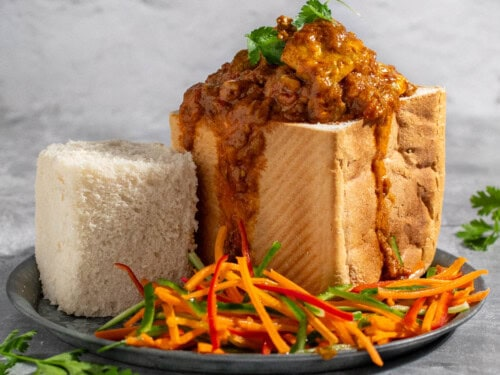
Bunny Chow is South Africa’s ultimate street food rebellion—a carb-on-curry collision that defies cutlery, defies refinement, and demands total sensory immersion. This hollowed-out loaf cradling incendiary curry isn’t just a meal; it’s Durban’s history in your hands, a portable feast born from apartheid-era ingenuity that became a national treasure.
🌍 A Dish of Resistance and Resourcefulness
Born in 1940s Durban’s Indian community, Bunny Chow emerged as ingenious takeaway for sugarcane laborers barred from restaurants during apartheid. Using bread as edible container (no utensils needed, no containers to return), it transformed curry into portable sustenance. The name’s origin remains deliciously debated: from “bania” (Indian merchant) to “bunny” (small loaf) to playful mispronunciation. This is food as political statement, cultural fusion, and street-smart innovation.
🛒 Ingredients: The Durban Trinity
The Curry Heart:
- 800 g mutton shoulder (bone-in preferred) or lamb/chicken
- Traditional: Goat or mutton (strong flavor stands up to spices)
- Alternative: Chicken thighs (bone-in for flavor)
- Vegetarian: Chickpeas, lentils, or mixed vegetables
- 2 large onions, finely chopped
- 4–6 garlic cloves, crushed
- 3–4 cm fresh ginger, grated
- 2–3 tbsp Durban masala (Rajah Extra Hot or similar)
- Non-negotiable: Standard curry powder lacks the heat and complexity
- 1 tsp turmeric powder
- 2 tsp garam masala
- 1–2 tsp ground cumin (toasted seeds ground fresh)
- 1–2 tsp ground coriander
- 2–3 fresh green chilies, slit lengthwise
- Optional: Bird’s eye chilies for authentic Durban heat
- 2–3 ripe tomatoes, chopped
- 2 medium potatoes, cubed (waxy variety like Desiree)
- 1 cinnamon stick and 2–3 curry leaves (traditional additions)
- 2 tbsp vegetable oil or ghee
- Salt to taste
- Coriander stems (cooked in curry) and leaves (garnish)
The Bread Vessel:
- 1 large unsliced white loaf (approx. 800g)
- Type: Square “government loaf” or shammy (soft white bread)
- Not: Artisan bread, sourdough, or crusty loaf (wrong texture)
- Alternative: 4 individual quarter loaves if available
- Butter for optional toasting
The Essential Accompaniments:
- Sliced carrots in vinegar (acar)
- Chopped onion and tomato salad with chili
- Extra chilies for brave souls
- Cold beer or ginger beer to extinguish flames
🔥 The Ritual: Step-by-Step Mastery
1. The Curry Foundation:
The Spice Preparation:
- Toast whole spices (if using): cumin, coriander, fenugreek
- Make paste: Blend onion, garlic, ginger with minimal water to smooth paste
- Traditional: Stone grinding (sil batta) for authentic texture
The Layered Cooking:
Step 1: The Tempering (Tadka):
- Heat oil/ghee in heavy pot (Dutch oven ideal).
- Add whole spices (mustard seeds, cumin seeds) if using—they should sizzle.
- Add curry leaves and cinnamon stick.
Step 2: The Onion Base:
- Add chopped onions, fry 10–12 minutes until deep golden brown.
- Not just translucent: Color = flavor foundation.
- Add ginger-garlic paste, fry 2–3 minutes until raw smell disappears.
Step 3: The Spice Bloom:
- Add Durban masala, turmeric, ground spices.
- Fry 2 minutes until oil separates and spices are fragrant.
- Critical: Undercooked spices taste raw and harsh.
Step 4: The Meat Transformation:
- Add meat, brown thoroughly on all sides.
- Take time: 8–10 minutes for proper caramelization.
- Add tomatoes, cook until they break down into sauce.
Step 5: The Slow Simmer:
- Add potatoes, whole green chilies, and water to cover.
- Simmer covered 45 minutes (chicken) to 90 minutes (mutton).
- Mutton/Goat: Until falling off bone
- Chicken: Until tender but not disintegrating
- Final consistency: Gravy should coat spoon, not be watery.
Step 6: The Finish:
- Stir in garam masala and coriander stems last 5 minutes.
- Adjust seasoning: Should be fiercely spicy, deeply savory.
- Rest curry 15 minutes before filling (flavors marry).
2. The Bread Engineering:
The Hollowing Technique:
- Cut loaf into quarters (or halves for “half bunny”).
- Tear out soft interior, leaving 1–1.5cm thick walls.
- Save removed bread for “saprini” (dippers).
- Optional: Lightly toast hollowed shells under grill for stability.
- Butter interior lightly (traditional but not universal).
The Filling Protocol:
- Warm bread slightly if not freshly baked.
- Place hollowed loaf on plate.
- Fill with curry until slightly mounded.
- Top with fresh coriander leaves.
- Serve immediately with removed bread pieces on side.
🖐️ The Eating Ceremony
The Street-Smart Method:
- Tear off top edge of bread.
- Scoop curry with bread piece.
- Eat from top down as bread softens.
- Eventually use hands to eat curry-soaked bread bowl.
- Finish with carrot salad to cleanse palate.
The Unspoken Rules:
- No forks allowed (purists will judge).
- Eat over plate—inevitable drips.
- Share if large—community eating is traditional.
- Cold drink mandatory—this is spicy business.
🎯 The Hallmarks of Perfect Bunny Chow
Visual Perfection:
- Bread structure: Holds shape initially, then yields to gravy
- Curry consistency: Thick enough not to leak, thin enough to soak
- Color contrast: Golden bread against rich, dark curry
- Garnish: Vibrant green coriander against red-brown curry
Texture Symphony:
- Bread exterior: Slightly crisp if toasted, otherwise soft
- Bread interior: Becoming gravy-soaked sponge
- Meat: Falling-apart tender
- Potatoes: Soft but holding shape
- Grave: Coating, not pooling
Flavor Balance (The Durban Fire):
- Heat: Front-and-center chili kick
- Spice: Complex layers from masala blend
- Savory: Deep meatiness or vegetable richness
- Sweet: Onion caramelization subtle background
- Fresh: Coriander finish cutting through richness
🗺️ Regional Variations: South Africa’s Bunny Map
1. Durban Original (The Gold Standard):
- Mutton or bean curry
- Extreme heat levels available (mild to “suicide”)
- Served in plastic bag with napkins
- From specific legendary shops (eg. Hollywood Bets, Goundens)
2. Cape Town Style:
- Often chicken or mince curry
- Slightly milder spice level
- Sometimes with sambals on side
- Served in cafes rather than street stalls
3. Johannesburg Adaptation:
- More variety: Butter chicken, vegetarian options
- Often deconstructed for restaurant presentation
- “Gourmet” versions with artisanal bread (controversial!)
4. Vegetarian Traditions:
- Bean bunny: Lentils or kidney beans
- Potato and pea curry
- Chickpea (channa) version
5. Modern Interpretations:
- Mini bunnies for parties
- Different breads: Whole wheat, rye (purists shudder)
- Fusion fillings: Thai curry, Mexican chili
- Deconstructed plates for fine dining
⚠️ The Non-Negotiable Rules
1. Bread Doctrine:
- White square loaf only—absorbency and texture are specific
- Hollow properly—thick enough walls to contain, thin enough to soak
- Fresh but not too fresh—day-old slightly better for structure
- Save the insides—wasting bread is bunny blasphemy
2. Curry Commandments:
- Durban masala essential—other curry powders lack the character
- Proper browning—of onions and meat = depth of flavor
- Adequate gravy—dry curry defeats the purpose
- Bone-in meat preferred—adds gelatin for sauce body
3. Spice Philosophy:
- Heat is mandatory—mild bunny chow is oxymoronic
- Layered spices—not just chili heat but complexity
- Balance—heat should enhance, not obliterate flavor
- Traditional accompaniments—carrot salad cuts through spice
4. The Forbidden List:
- No utensils (defeats the purpose)
- No fancy bread (sourdough, baguettes, etc.)
- No thin/watery curry (leaks and creates mess)
- No serving cold (must be piping hot)
- No eating daintily (embrace the mess)
🧪 The Science of the Soak
Why It Works:
- Starch Gelatinization: Bread starch absorbs liquid, softens without disintegrating
- Fat Emulsion: Curry fats coat bread, carry flavor deep into structure
- Thermal Mass: Thick bread walls insulate, keeping curry hot
- Edible Container: No waste, no washing—pure practicality
Common Failure Points:
- Soggy collapse: Bread too thin, curry too watery, filled too early
- Dry bread walls: Not enough gravy, bread too thick, eaten too quickly
- Leaking disaster: Overfilled, bread tear, incorrect curry consistency
- Bland experience: Underseasoned curry, wrong spice blend, poor quality meat
🍺 Perfect Pairings: The Durban Way
Beverages:
- Beer: Castle Lager or Black Label (ice cold)
- Ginger beer: Stoney or homemade
- Soda: Coca-Cola (surprisingly effective against heat)
- Buttermilk or lassi (traditional cooler)
The Complete Street Food Experience:
- Order at counter: “Half mutton bunny, extra hot”
- Receive in plastic bag with napkins
- Find spot on pavement or in car
- Eat immediately while steaming hot
- Follow with carrot salad and cold drink
- Wipe hands, satisfied smile
Serving Context:
- Late-night after clubs/bars
- Lunch break for workers
- Sporting events (especially cricket)
- Beach outings in Durban
- Any time craving hits
📜 The Cultural Experience
Bunny Chow is Durban’s edible identity:
- Apartheid-era ingenuity turned national icon
- Cross-cultural bridge between Indian, Zulu, and other communities
- University student staple—cheap, filling, delicious
- Tourist pilgrimage to original shops
The ritual of eating—the tearing, scooping, inevitable drips—creates camaraderie. This isn’t private dining; it’s shared, messy, joyful communal eating. The burning heat followed by cooling relief is addictive rhythm.
Final Durban Wisdom: “A bunny isn’t eaten—it’s experienced. If your nose isn’t running and your brow isn’t sweating, it’s not a proper bunny. And if you’re not using your hands, you’re just eating curry with bread.”
Serve with confidence, eat with abandon, and taste the history, resilience, and flavor of Durban in every spicy, carb-loaded bite.
Lekker eet! (Delicious eating!) 🇿🇦✨
The World’s Street Food Journey Continues
From Indonesia’s wok-fired rice to Durban’s curry-filled loaves, from Australasia’s delicate pavlovas to Greece’s slow-stolen lamb—these dishes form a global celebration of ingenuity, community, and bold flavor.
Bunny Chow teaches us: How constraints breed creativity, and how food can be both practical container and profound cultural expression.
May your bread always be fresh, your curry always fierce, and your hands always ready to eat without utensils.
Happy cooking, and may your bunny always be authentically messy! 🌍👨🍳🔥
The world’s street wisdom is in your kitchen. Cook with history, serve with pride, eat with joy.
Leave a Reply