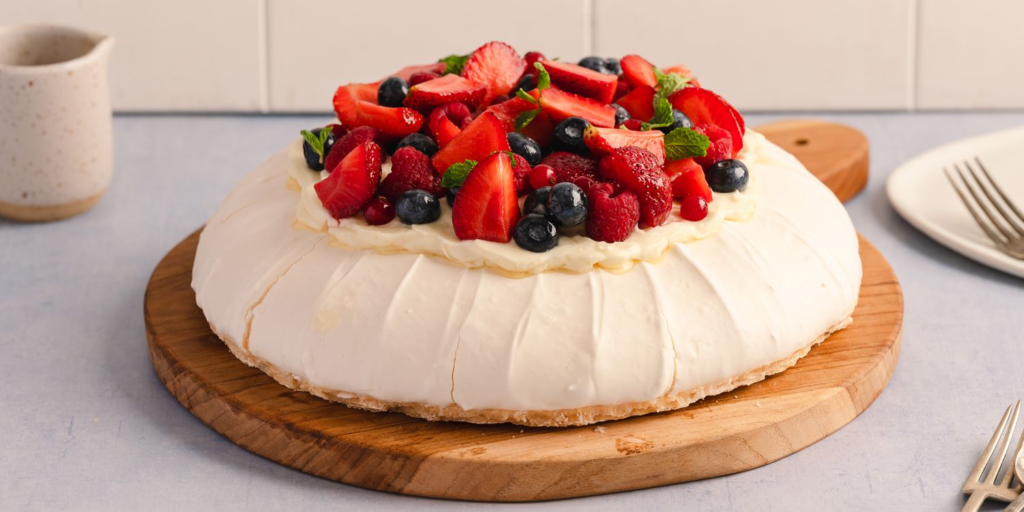
Taste of heaven – Pavlova is more than dessert—it’s a trans-Tasman trophy, a summer’s day captured in sugar and air, a delicate structure that embodies both grace and national pride. This crisp-shelled, marshmallow-hearted meringue, crowned with billowy cream and jewel-like fruits, represents the sweetest rivalry on Earth and the ultimate celebration of Southern Hemisphere summers.
🩰 A Dessert Born of Dance and Debate
Created in the 1920s-30s in honor of Russian ballerina Anna Pavlova during her Australasian tours, the pavlova’s origins are deliciously disputed. Australians claim Perth chef Herbert Sachse created it in 1935; New Zealanders insist it appeared in a 1929 rural cookbook. What’s undeniable is that both nations have embraced this dessert as edible patriotism—light as a ballerina’s tutu, celebratory as a summer Christmas.
🛒 Ingredients: The Airy Architecture
The Meringue (The Cloud):
- 6 large egg whites (approx. 200g), room temperature
- Age: 3–5 days old separates more cleanly
- Temperature: Critical—cold egg whites won’t achieve full volume
- Purity: No yolk traces—fat prevents proper foaming
- 300 g caster sugar (superfine sugar)
- Not granulated: Fine crystals dissolve completely
- Optional: Replace 50g with icing sugar for slightly softer interior
- 1½ tsp white vinegar (or lemon juice)
- Science: Acid stabilizes egg white foam
- 1½ tsp cornflour (cornstarch)
- Purpose: Creates marshmallow interior, prevents weeping
- 1 tsp vanilla extract (pure, not imitation)
- Pinch of salt (enhances flavor, stabilizes foam)
The Cream (The Cloud’s Pillow):
- 500 ml heavy cream (min. 35% fat), chilled
- Not whipping cream: Needs higher fat for stability
- Temperature: Bowl and beaters chilled 15 minutes
- 2–3 tbsp icing sugar (confectioners’ sugar), sifted
- 1 tsp vanilla extract or paste
- Optional stabilizer: 1 tbsp cornflour mixed with 2 tbsp cream
The Fruit Crown (The Jewels):
- 3–4 ripe kiwifruit, peeled and sliced
- Green or gold: Both traditional
- 250 g strawberries, hulled and halved
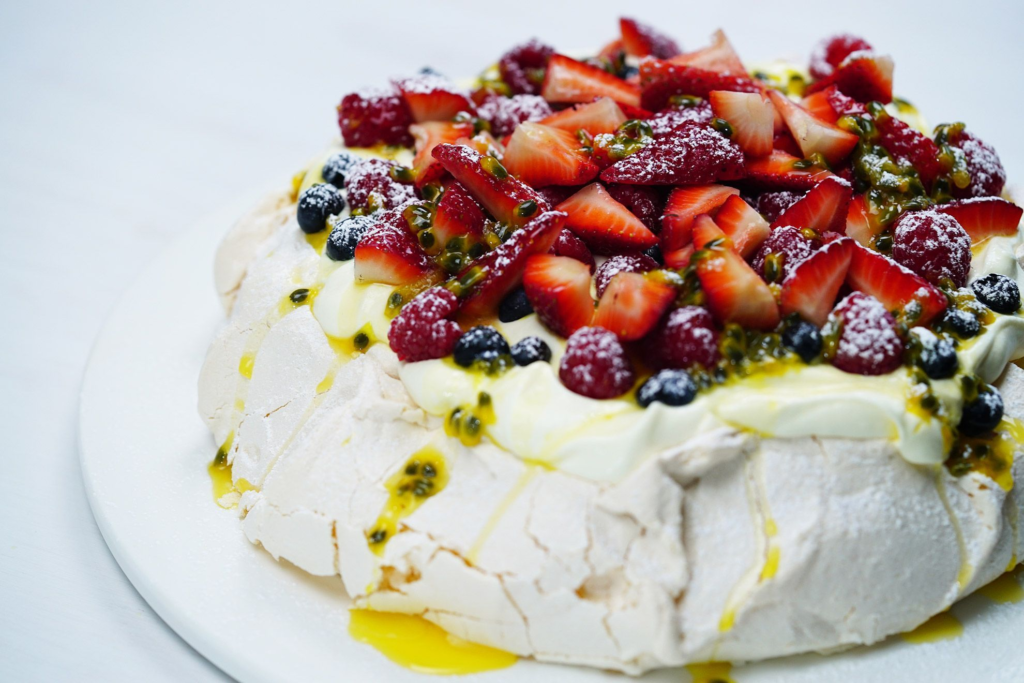
- Pulp of 3–4 passionfruit (or ¼ cup bottled pulp)
- Non-negotiable: Passionfruit is quintessential
- Handful of raspberries and blueberries
- Optional: Sliced mango, peaches, or pineapple in season
Optional Enhancements:
- Passionfruit curd or lemon curd (swirled through cream)
- Toasted coconut flakes or chopped nuts
- Fresh mint leaves for garnish
- Edible flowers (pansies, violets) for special occasions
Equipment:
- Stand mixer with whisk attachment (hand mixer possible but challenging)
- Digital kitchen scale (volume measurements unreliable for meringue)
- Baking tray lined with parchment or silicone mat
- Pencil for drawing circle
- Offset spatula for shaping
- Wire rack for cooling (optional)
⏳ The 24-Hour Ballet: Step-by-Step Mastery
DAY 1: THE MERINGUE (The Patient Cloud)
1. The Preparation Ritual:
- Preheat oven to 130°C (265°F) conventional or 110°C (230°F) fan-forced.
- Note: Many home ovens run hot—use oven thermometer.
- Draw 22cm circle on parchment paper (plate as template), flip paper over.
- Ensure mixing bowl and whisk are spotlessly clean, grease-free:
- Wash with vinegar, rinse thoroughly, dry completely.
- Even trace fat will prevent proper whipping.
- Separate eggs when cold (easier), then bring whites to room temperature (1–2 hours).
- Pro trick: Place egg whites in bowl over warm (not hot) water to speed warming.
2. The Meringue Alchemy:
Stage 1: The Foam Foundation:
- Beat egg whites with pinch of salt on medium speed until foamy.
- Increase to medium-high, beat until soft peaks form.
- Test: Lift whisk—peaks should curl over, not hold straight.
Stage 2: The Sugar Snow:
- Gradually add caster sugar, 1 tablespoon every 30 seconds.
- Scrape bowl occasionally to ensure even incorporation.
- Continue beating until:
- Stiff, glossy peaks (peaks stand straight)
- Sugar completely dissolved (rub pinch between fingers—no grittiness)
- Time: 8–10 minutes total
- The meringue should be so thick the whisk leaves clear trails.
Stage 3: The Stabilizers:
- Sprinkle vinegar, cornflour, and vanilla over meringue.
- Fold gently 8–10 times until just combined—don’t deflate.
3. The Sculpting:
- Spoon meringue into drawn circle.
- Shape with offset spatula:
- Build sides slightly higher than center (creates well for cream)
- Create swirls and peaks on surface (will brown attractively)
- Smooth sides for structural integrity
- Final shape: Should resemble shallow nest or volcano.
4. The Oven Meditation:
- Bake 1 hour 15 minutes (for 22cm pavlova).
- Signs of doneness: Pale cream color, dry surface
- No opening oven—temperature shock causes cracks
- Turn oven off, prop door slightly ajar with wooden spoon.
- Cool completely in oven minimum 4 hours, ideally overnight.
- This gradual cooling prevents collapse and cracking.
DAY 2: THE GRAND ASSEMBLY
5. The Cream Whipping (Last Minute):
- Chill bowl and beaters 15 minutes in freezer.
- Whip cream, icing sugar, and vanilla to soft-medium peaks.
- Not stiff: Should still flow slightly
- Over-whipped cream weeps and separates
- Optional: Fold through passionfruit curd for marbled effect.
6. The Fruit Preparation:
- Prepare fruit just before assembly to prevent browning/juicing.
- Kiwi: Slice, pat dry if very juicy
- Strawberries: Hull, halve or slice
- Passionfruit: Scoop pulp, reserve some for drizzling
7. The Finale (30 Minutes Before Serving):
The Assembly:
- Transfer meringue to serving plate (use two spatulas).
- Spread cream evenly over top, leaving 2cm border.
- Arrange fruit artistically:
- Traditional: Kiwi slices in concentric circles, strawberries around edge
- Modern: Artful piles of mixed fruit
- Drizzle passionfruit pulp over everything.
- Add final garnishes: Mint, coconut, flowers.
The Timing:
- Assemble maximum 30 minutes before serving
- Meringue stays crisp about 2 hours after cream added
- Serve immediately once assembled
🎄 The Southern Hemisphere Christmas Pavlova
Festive Variations:
- Colors: Red and green fruit (strawberries, kiwifruit, mint)
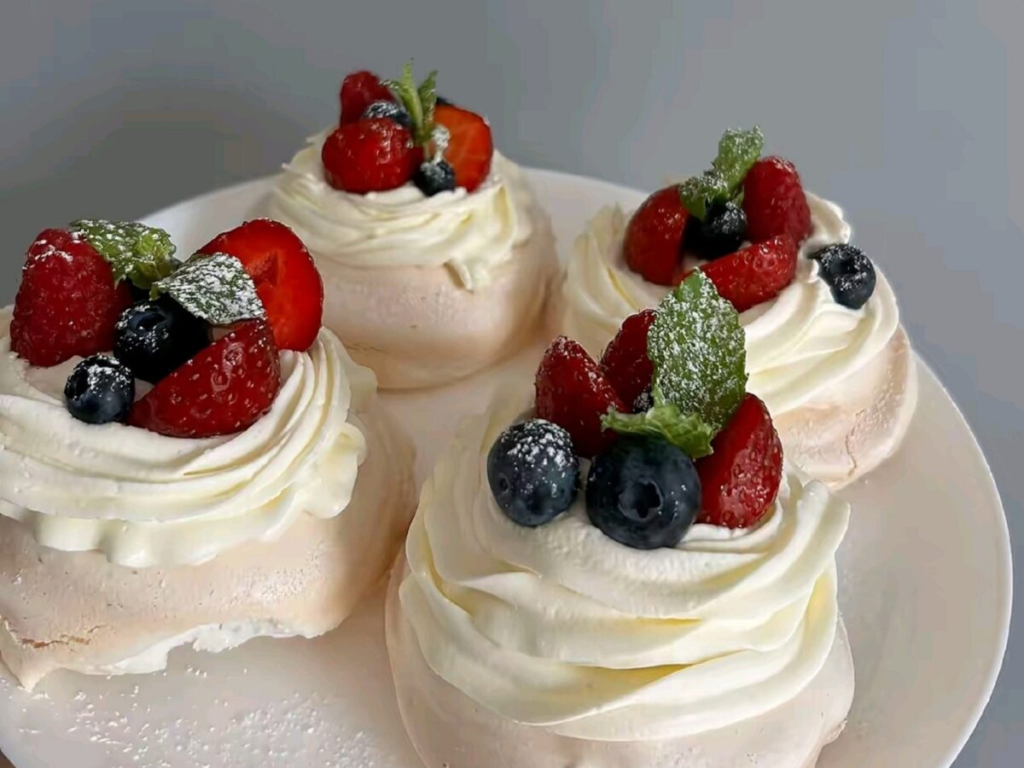
- Shapes: Individual mini pavlovas (bake 45 minutes)
- Flavors: Add peppermint extract to cream
- Presentation: On cake stand with holly garnish
🎯 The Hallmarks of Perfect Pavlova
Visual Perfection:
- Shell: Pale beige with slight cracking (character, not defect)
- Topography: Slightly sunken center, crisp peaks on edges
- Color contrast: White cream against colorful fruit
- Structure: Holds shape when transferred, not sagging
Texture Symphony:
- Exterior: Crisp, shattering shell (like delicate glass)
- Interior: Marshmallow-soft, moist, not sticky
- Cream: Light, pillowy, not greasy
- Fruit: Juicy but not dripping
Flavor Balance (The Southern Trinity):
- Sweet: Meringue and cream sweetness
- Tart: Passionfruit and berries cutting through
- Vanilla: Subtle perfume throughout
- Clean: No eggy taste (indicator of properly baked meringue)
🗺️ The Trans-Tasman Rivalry: Two Nations, One Dessert
Australian Style:
- Often taller, more cake-like
- Passionfruit essential (sometimes passionfruit pulp in meringue)
- Served at barbecues and summer gatherings
- Common additions: Mango, pineapple
New Zealand Style:
- Slightly crispier shell
- Kiwifruit prominently featured (New Zealand’s national fruit)
- Christmas tradition with strawberries and kiwifruit
- Sometimes includes feijoa in season
Common Ground:
- Both claim invention (friendly but fierce debate)
- Both consider it national dessert
- Both serve at celebrations
- Both insist theirs is superior
⚠️ The Non-Negotiable Rules
1. Egg White Doctrine:
- Room temperature—cold = less volume
- No yolk traces—fat prevents foaming
- Old eggs preferred—3–5 days separates better
- Copper bowl ideal (stabilizes naturally) but not essential
2. Sugar Science:
- Caster sugar only—granulated won’t dissolve completely
- Add gradually—dumped sugar deflates foam
- Beat until dissolved—gritty meringue weeps
- No reducing sugar—structure depends on precise ratio
3. Baking Physics:
- Low and slow—high heat causes browning and cracking
- Don’t open oven during baking or initial cooling
- Cool in oven—prevents thermal shock collapse
- Humidity enemy—avoid rainy days if possible
4. The Forbidden List:
- No cream of tartar (traditionalists insist vinegar only)
- No assembling ahead (becomes soggy)
- No refrigeration after baking (absorbs moisture)
- No plastic wrap touching meringue (sticks terribly)
🧪 The Science of the Shell
Why It Works:
- Protein Denaturation: Egg whites unfold and trap air bubbles
- Sugar Syrup: Dissolved sugar forms syrup that hardens when baked
- Acid Stabilization: Vinegar strengthens protein network
- Cornflour Action: Absorbs excess moisture, creates marshmallow texture
- Slow Drying: Low heat removes moisture gradually without browning
Common Failure Points:
- Weeping/beading: Sugar not fully dissolved, humidity too high
- Collapse: Opened oven during cooling, underbaked, moved while hot
- Tough shell: Overbaked, oven too hot
- Brown spots: Oven hot spots, sugar too close to heating element
- Rubbery interior: Too much vinegar or cornflour
🍷 Perfect Pairings: The Southern Hemisphere Way
Beverages:
- Dessert wine: Australian botrytis semillon or NZ late harvest riesling
- Sparkling: Australian sparkling shiraz or NZ methode traditionnelle
- Coffee: Flat white or long black
- Tea: English breakfast with milk
The Complete Summer Celebration:
- Starters: Prawns on barbecue, oysters
- Main: Lamb chops or grilled fish
- Salads: Multiple fresh salads
- Dessert: Pavlova with coffee
- After: Port or liqueurs
Christmas Day (Southern Hemisphere):
- Served after hot Christmas lunch
- With champagne or summer cocktails
- Children get first pick of fruit
- Leftovers for Boxing Day (though rarely any left)
📜 The Cultural Experience
Pavlova is summer celebration embodied:
- Christmas table centerpiece in Australia/NZ
- Wedding dessert alternative to fruitcake
- School fundraiser staple
- Family rivalry: Whose pav is best?
The sound of cracking the shell—that first spoon breaking through crisp exterior to soft interior—is anticipated joy. The visual spectacle of a perfectly decorated pavlova carried to the table elicits collective admiration.
Final Australasian Wisdom: “A good pav should look like it might float away but taste like it’s anchored in summer. The shell should crack, not crunch. The center should sigh, not squelch.”
Serve with pride, share generously, and let each bite settle the great debate—or better yet, continue it with good humor and second helpings.
Happy baking, and may your meringue always stand tall! 🇦🇺🇳🇿✨
The World’s Oven Continues Baking
From Indonesia’s fiery woks to Australasia’s delicate ovens, from Greece’s lamb parcels to Portugal’s blistering tarts—these dishes form a global celebration of technique, tradition, and shared joy.
Pavlova teaches us: How air and patience can create edible clouds, and how friendly rivalry can sweeten national identity.
May your egg whites always be fat-free, your sugar always fine, and your summer tables always have room for one more slice of cloud.
Happy baking, and may your pavlova never weep! 🌍👨🍳☁️
The world’s sweetness is in your whisk. Whip with care, bake with patience, serve with joy.
Leave a Reply